How We Test Laptops – Best Laptop Guide
The methodology behind every comparison, review, and recommendation on this site.
Marcus Hale IT Administrator & Virtualization Specialist · Lead Writer, Best Laptop Guide
Table of Contents
Most laptop review methodology pages read like a press release. They list the benchmarks they run, describe the tools they use, and leave out the part that actually matters — the thinking behind why those tests were chosen and what they’re genuinely measuring.
This page explains how I actually test. Not what tools I run, but what I’m trying to find out, why certain tests matter and others don’t, and what happens when I get a result I didn’t expect.
Why I don’t lead with synthetic benchmarks
Cinebench R23. PCMark 10. 3DMark Time Spy. These are useful numbers. I run them. But I’ve also spent eleven years in IT administration managing infrastructure and virtualization environments, and what I’ve learned from watching real hardware under real load is that benchmark scores and daily-use experience often tell different stories.
A laptop can post an impressive Cinebench multicore score in a two-minute burst and then thermal-throttle its way to mediocrity the moment you ask it to sustain that workload for twenty minutes. A chip rated “faster” in a synthetic single-core test might underperform a nominally slower chip in the specific application you actually use, because of how that application distributes work across cores.
I’ve also watched two laptops with identical spec sheets perform differently — same CPU, same GPU, same RAM — because one manufacturer configured the thermal design and TGP (Total Graphics Power) more conservatively than the other. The spec sheet doesn’t tell you that. A benchmark run at the start of a session often doesn’t either.
The question I’m actually trying to answer is: what is it like to use this machine for the thing you’re going to use it for, over the course of a real session — not the first five minutes?
Benchmarks are one input into that answer. They’re not the answer itself.
Setup before testing begins
Before any testing starts, every machine goes through the same preparation:
1. Full software update
Windows updates, driver updates, firmware updates — all applied before any testing begins. A machine tested on day-one drivers with unpatched firmware is not the machine a buyer will be using two weeks after purchase.
2. Manufacturer bloatware assessed, not automatically removed
I note what’s pre-installed and whether it affects performance. Bloatware removal is documented when done — the out-of-box experience matters for most buyers, and I don’t want to test a cleaned-up machine and call it representative.
3. Power mode set to match the use case
Performance mode for gaming and heavy workload tests. Balanced for everyday use and battery testing. I document which mode was active for each result — same machine, different mode settings can produce meaningfully different numbers.
4. 30-minute warm-up before thermal testing
Cold-start performance tells you almost nothing useful. I run a 30-minute mixed workload before any thermal or sustained-performance measurements begin. This is where throttling behaviour — if there is any — starts to show.
5. Screen brightness standardised
70% brightness for all battery tests. Not 30%, not auto. The “up to 12 hours” claim on a box is almost always measured at a brightness level no one actually uses. I want the number that reflects a real working session.
The testing process, step by step
Sustained performance — not burst
Every performance test runs for a minimum of 45 minutes of continuous load. I’m specifically looking for whether performance at the 40-minute mark is consistent with performance at the five-minute mark. Throttling that only appears after sustained load is the most common thing that separates a laptop that feels fast from one that feels fast in a store and slow at a desk.
I log CPU clock speeds, GPU clock speeds, and temperatures throughout. The pattern matters as much as the peak number — a chip running at a steady 3.4GHz under sustained load is often more useful than one that boosts to 4.8GHz for thirty seconds and then sits at 2.9GHz for the rest of the session.
Concurrent workloads — not isolated tasks
Real use doesn’t isolate tasks. You don’t close your browser to render a video. You don’t pause Spotify while running a spreadsheet. Testing a laptop with one application open and calling it a productivity result is not testing a productivity laptop.
For every use-case category, I define a representative concurrent workload and run it consistently across machines being compared. The point is not maximum stress — it’s a realistic representation of what the person this machine is aimed at will actually be running.
Battery at real brightness, real load
The battery test I trust most is: screen at 70% brightness, a mixed workload running (not idle, not video playback only), Wi-Fi connected. I run this until the machine hits 10% and auto-hibernates. That number is the battery life result I report. It will be lower than the manufacturer’s claim. That’s the point.
Build quality and physical assessment
Spec sheets don’t capture keyboard flex, hinge resistance, trackpad responsiveness, fan noise under load, or how a chassis handles being opened and closed one-handed. I assess all of these during the extended testing period, not in a five-minute first-impressions session. A keyboard that feels fine for ten minutes can become irritating after two hours of sustained typing.
How workloads differ by use case
Office / Everyday
- Chrome: 15–20 tabs open
- Microsoft Teams or Zoom running
- Word / Google Docs with active document
- PDF open in background
- Spotify streaming
Gaming
- Title-specific frame rate at 1080p medium and high settings
- GPU TGP and temperature tracked throughout
- Fan noise measured at peak load
- Discord running in background
- 45-minute session minimum per title
Student / Campus
- Battery test at 70% brightness, mixed workload
- Keyboard assessed over 2-hour typing session
- Weight and bag portability noted
- Webcam quality for video calls
- Fan noise in silent environments
Creative / Content
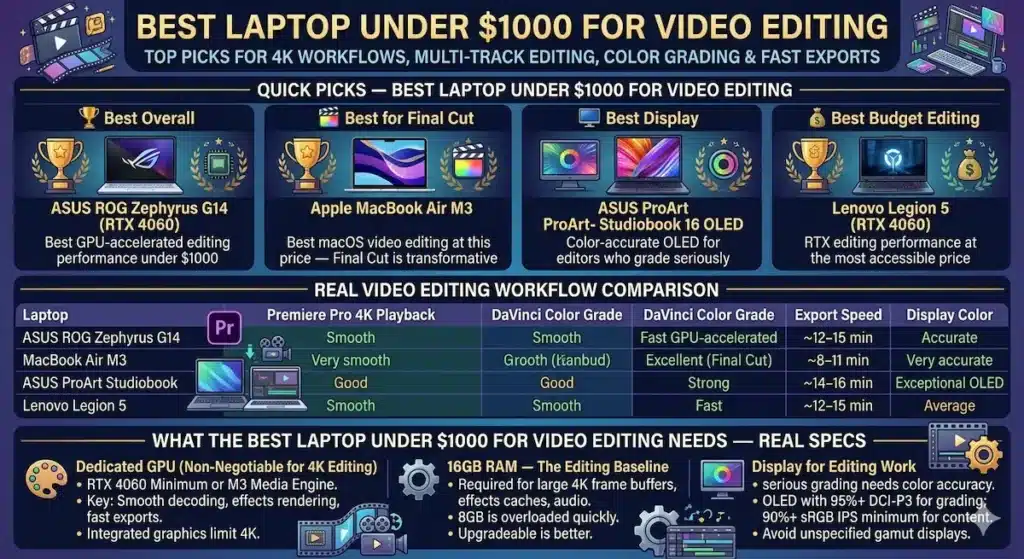
- Video export timed (same project file across machines)
- Photo editing with large RAW files
- Thermal behaviour during 30-min render
- Display colour accuracy assessed visually
- RAM pressure with multiple apps open
What I report — and what I don’t
I report the results I actually got, including when they contradict what I expected going in. If a budget machine outperforms a more expensive one on the workload that matters for the comparison, that’s the result. I don’t adjust framing to protect a recommendation I’ve already made.
I don’t report single-run benchmark peaks as representative performance. If a machine scores well on the first Cinebench run and drops 20% on the second run due to thermal limits, I report the sustained figure, not the peak. I note the drop.
When I get a result I didn’t expect
It happens. I’ve expected a Ryzen 7 configuration to outperform a Ryzen 5 on a specific workload and found the difference was smaller than the price gap justified. I’ve expected a gaming laptop’s GPU to deliver consistent frame rates and found it throttled earlier than the spec suggested.
When this happens, I say so. The article explains what I expected, what I found, and what that means for the buying decision. The point is accurate information, not a clean story.
How verdicts are reached
Every comparison article ends with a verdict. The verdict reflects the testing results weighted by the use case — a machine that wins on raw performance but runs hot and loud is not the right verdict for a student buying a library laptop, even if it tops the benchmark chart.
I factor in value. A machine that scores 10% better on performance but costs 40% more is not automatically the recommendation. The verdict answers the question the article’s title asks — it doesn’t just declare the fastest machine the winner.
I factor in what’s likely to still be true in two years. A laptop with a well-documented thermal design, a serviceable battery, and solid build quality is a better long-term buy than one that benchmarks impressively on day one but has a track record of degrading. My eleven years in IT administration includes watching enough enterprise laptop fleets age to have opinions about which manufacturers build machines that last.
Corrections and updates
Laptop specs change. Prices shift. Drivers update and performance changes. A recommendation that was accurate in October may not be accurate in April.
I update articles when the information has changed materially — and I note the update at the top of the article with a “Last Updated” date. I don’t quietly change content and leave old dates in place.
If you’ve found something in an article that’s outdated or factually wrong, I want to know. The fastest way to reach me is the contact page. If a correction checks out, I’ll update the article and note the change.
Affiliate & editorial disclosure: Best Laptop Guide participates in affiliate programs including Amazon Associates. Some links in articles may earn a small commission if you purchase through them, at no extra cost to you. Commissions do not influence which products are recommended or how they are rated. No free hardware, sponsorship, or payment from any laptop manufacturer has been accepted by this site. For full details, see our Affiliate Disclosure and Disclaimer.