Last Updated: May 2026 | Author: Marcus Hale | Reading Time: 11 min
The extended warranty pitch happens at the same moment every time.
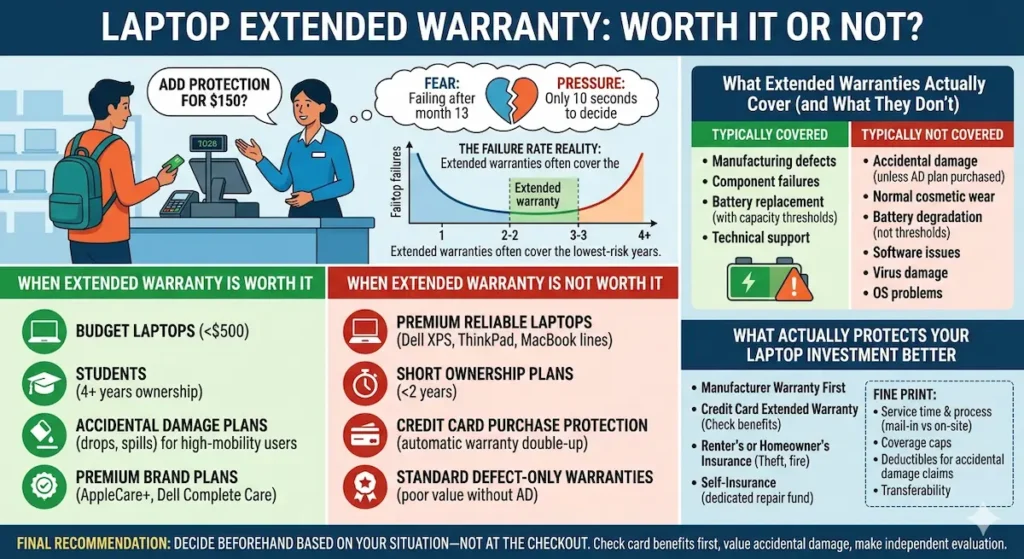
You’ve spent forty-five minutes selecting a laptop, you’re at the register or the checkout screen, and suddenly you’re being asked to add $150 for protection that “covers everything.” The sales pressure is real. The fear of a $700 laptop failing at month thirteen is real. And the ten seconds you have to make the decision is not enough to think it through clearly.
So you say yes. Or you say no and immediately wonder if you made a mistake.
13 Inch vs 15 Inch Laptop for College
The extended warranty for laptops — worth it or not question deserves a proper answer rather than a split-second judgment under pressure. I’ve looked at what extended warranties actually cover, what the failure rate data says about when laptops actually break, and where the money genuinely goes when you buy protection.
Here’s the honest breakdown.
Table of Contents
What Extended Warranties Actually Cover (And What They Don’t)
Understanding the extended warranty for laptops worth it or not question starts with reading what these plans actually cover — because most buyers who feel burned by extended warranties were burned by limitations they didn’t read before purchasing.
What most laptop extended warranties cover:
- Manufacturing defects that appear after the manufacturer’s warranty expires
- Component failures (motherboard, keyboard, display) from normal use
- Battery replacement in some premium plans (with capacity thresholds — usually below 50–75% of original)
- Technical support and diagnostic services
What most laptop extended warranties do NOT cover:
- Accidental damage (drops, spills) — unless you specifically purchase an Accidental Damage plan
- Normal cosmetic wear (scratches, worn keys, hinge scuffs)
- Battery degradation that hasn’t crossed the coverage threshold
- Software issues, virus damage, or OS problems
- Damage from “misuse” — a term that covers a surprisingly wide range of situations in the fine print
This distinction between manufacturer defect coverage and accidental damage coverage is where the extended laptop warranty worth it debate pivots most critically. A standard extended warranty that doesn’t cover accidental damage protects against a failure mode (manufacturing defect after year one) that is statistically rare. An accidental damage plan covers the failure mode (drops, spills, physical damage) that is far more common among students and mobile professionals.
The Failure Rate Reality — When Laptops Actually Break
The most important context for the extended warranty for laptops — worth it or not decision is understanding when laptops actually fail.
Consumer electronics failure rate data consistently shows that laptop failures cluster in two periods:
Early failures (first year): Manufacturing defects that appear during initial use. These are covered by the manufacturer’s standard one-year warranty. Extended warranties don’t add coverage here.
Late failures (after year 3–4): Component wear that accumulates with age. Battery degradation, hinge loosening, keyboard wear, and eventual motherboard failure from years of thermal cycling. Extended warranties typically cover years 2–3, which is the period statistically least likely to produce covered failures for quality laptops.
The bathtub curve of electronics reliability means the period between initial defects and end-of-life wear — roughly years 1–4 for most mid-range laptops — is the lowest-failure period. This is precisely the period that most extended warranties cover. And this is why failure rate data consistently shows that most extended warranties never get used for a qualifying claim.
The honest extended warranty laptop review reality: for budget and mid-range laptops that genuinely show higher failure rates, extended warranties make more statistical sense. For premium laptops ($1,000+) with lower historical failure rates, the math often doesn’t favor the buyer.
Extended Warranty for Laptops Worth It or Not — By Situation
Rather than a universal answer, the extended warranty for laptops — worth it or not question resolves clearly for specific situations.
When Extended Warranty IS Worth It
Budget laptops under $500. Budget machines have higher component failure rates than premium alternatives. A $150 extended warranty on a $450 laptop represents 33% of the machine’s value — a high premium, but one that’s more statistically justified given the higher failure likelihood of budget hardware. If a single covered repair (keyboard, charging port, display) would approach $150–$200 in out-of-pocket repair cost, the warranty breaks even on one claim.
Students who keep laptops for 4+ years. Standard manufacturer warranties cover year one. Extended warranties typically cover years 2–3. For students who intend to use a machine across a full four-year degree, the extended coverage period aligns better with the realistic ownership duration. A failure in year two or three — while not the most likely outcome — has more coverage value for a four-year ownership plan than for a two-year plan.
Accidental damage plans for high-mobility users. This is where the is extended warranty worth it for laptop answer shifts most clearly to yes. Students who carry laptops daily across campus, professionals who travel frequently, and anyone in a high-drop-risk environment benefit from accidental damage protection in a way they don’t benefit from standard defect-only coverage. A $120–$200 accidental damage plan that covers screen replacement ($200–$400) or motherboard damage from liquid exposure ($200–$500+) provides coverage for failures that actually happen.
Premium brand plans (AppleCare+, Dell Complete Care). Manufacturer-extended warranties from Apple, Dell, and Lenovo often provide meaningfully better coverage terms than third-party retailer plans. AppleCare+ includes accidental damage with a service fee ($99 for screen damage, $299 for other damage) and provides coverage from Apple’s own service network with documented reliability. For Apple products specifically, AppleCare+ has a better consumer track record than generic extended warranties from retailers.
When Extended Warranty Is NOT Worth It
Premium laptops from reliable brands. Premium laptops from Dell XPS, Lenovo ThinkPad, and Apple MacBook lines have lower component failure rates than budget alternatives. The statistical case for extended coverage is weaker, and the higher purchase price makes the extended warranty a larger percentage of total cost.
Standard defect-only warranties without accidental damage. For mobile students and professionals, the coverage gap — excluding the most likely failure mode — makes standard extended warranties a poor value. Paying $150 for a plan that doesn’t cover the spill or drop that’s actually most likely to happen provides minimal practical protection.
Best Laptop Under $500 for Video Editing
Short ownership intentions. If you realistically plan to replace or upgrade the laptop within two years, extended warranty coverage for years two and three has limited value. The coverage period doesn’t align with your likely ownership window.
When you have credit card purchase protection. Many US credit cards — particularly Visa Signature, Mastercard World Elite, Chase Sapphire, and American Express cards — include automatic extended warranty protection that doubles the manufacturer warranty up to one additional year at no extra cost. Paying $150 for a retailer extended warranty when your credit card already provides equivalent coverage is paying for duplicate protection.
Buy Apple Care+What Actually Protects Your Laptop Investment Better
Understanding the extended warranty for laptops worth it question completely means knowing what alternatives exist.
Manufacturer Warranty First
The one-year manufacturer warranty covers the failures most likely to occur early in ownership. Register your laptop with the manufacturer immediately after purchase to ensure full warranty coverage documentation. Keep your purchase receipt. This base coverage is often underutilized because buyers don’t know what it includes.
Credit Card Extended Warranty
Check your credit card benefits before purchasing any extended warranty. Many major US credit cards automatically extend the manufacturer’s warranty by one year on eligible purchases charged to the card. This effectively provides two-year coverage at no additional cost — the same as a basic retailer extended warranty — with no separate plan to manage or service fee to pay.
Renter’s or Homeowner’s Insurance
Personal property coverage under renter’s or homeowner’s insurance often covers electronics against theft, fire, and some accidental damage. For college students specifically, many renter’s insurance policies cover laptop theft from dorm rooms and campus environments — a failure mode that extended warranties never cover.
Self-Insurance
For users who don’t drop laptops and maintain them carefully, setting aside the $120–$150 extended warranty cost as a dedicated repair fund provides equivalent financial protection with complete flexibility. If the machine never needs repair, you keep the money. If it does, the fund covers a typical single repair — which is what the warranty would have paid.
Extended Warranty for Laptops — The Fine Print That Matters
When is extended warranty worth it for laptop purchases depends significantly on specific plan terms that buyers rarely read before purchasing.
Service time and process: Some plans require mailing the laptop and waiting 2–3 weeks for repair. For students with active coursework or professionals with work-critical machines, this service model creates a real problem alongside the hardware failure. Look for plans that offer on-site service or loaner machine provisions.
Coverage caps: Some extended warranties cap repair costs at the original purchase price or a percentage of it. A plan that caps coverage at $200 on a $600 laptop has limited practical value if the covered failure (motherboard replacement) costs $350.
Deductibles: Some accidental damage plans include deductibles of $50–$100 per claim. The effective cost of coverage is the plan premium plus any deductible — factor this into the value calculation.
Transferability: Extended warranties on laptops you might sell or give away before the coverage period ends have limited value. Some plans are non-transferable, meaning the coverage disappears if you sell the machine before expiration.
Exclusions for pre-existing conditions: Some plans exclude any issue that existed before warranty purchase, which can be broadly interpreted by service providers in ways that deny legitimate claims.
The Retailer Pressure Reality
The extended warranty for laptop worth it decision is made harder by the sales environment in which it’s typically presented.
Retailers earn significantly higher margins on extended warranties than on the laptops themselves — often 50–80% gross margin on warranty products versus 5–15% on hardware. This creates structural pressure for staff to recommend warranties regardless of the customer’s actual situation or the statistical likelihood of claim.
Best Refurbished Laptop Under $500
Understanding this incentive structure doesn’t mean never buying an extended warranty — it means evaluating it independently rather than under sales pressure. The best time to research the extended warranty for laptops — worth it or not question is before you’re at the register, not during the transaction.
Frequently Asked Questions
Is extended warranty worth it for a laptop in 2026?
For standard defect-only coverage on a premium laptop: usually not — credit card warranty extension typically provides equivalent coverage at no extra cost. For accidental damage plans on student laptops and high-mobility devices: worth serious consideration, as it covers the failure mode that actually happens most frequently.
Should I get AppleCare+ for a MacBook?
AppleCare+ is among the better-value extended warranty for laptop options because it includes accidental damage with a capped service fee, uses Apple’s own service network, and has a documented track record of honored claims. For MacBook users who carry their laptop daily and want peace of mind, AppleCare+ is worth evaluating. It’s more valuable than generic retailer extended warranties.
Does my credit card cover extended warranty on a laptop?
Many major US credit cards — Visa Signature, Mastercard World Elite, Chase Sapphire, American Express — automatically extend the manufacturer warranty by one year on purchases charged to the card. Check your credit card benefits guide specifically before purchasing any extended laptop warranty at retail.
What is the difference between extended warranty and accidental damage protection?
Extended warranty covers manufacturing defects that appear after the standard warranty expires. Accidental damage protection covers physical damage from drops, spills, and impacts. For most laptop users, accidental damage is a far more likely failure mode than manufacturing defect — making accidental damage protection the more practically valuable coverage for mobile users.
Are third-party laptop extended warranties worth buying?
Generally less reliable than manufacturer-direct extended warranties. Third-party plans have more variable claim approval rates, less predictable service quality, and more opportunity for coverage disputes. If purchasing extended coverage, manufacturer-direct plans (AppleCare+, Dell Complete Care, Lenovo Premium Care) typically provide more reliable claim experiences.
Final Recommendation
The extended warranty for laptops — worth it or not question has a clear answer for most buyers: check your credit card benefits first, evaluate accidental damage coverage separately from defect coverage, and make the decision based on your actual usage patterns rather than register-line pressure.
Buy extended coverage when: you’re purchasing a budget laptop with higher failure likelihood, you’re a student or mobile professional with significant drop and spill risk who wants accidental damage coverage, or you’re buying a premium manufacturer plan (AppleCare+) that provides meaningful accidental damage terms.
Skip it when: your credit card already extends the warranty, you’re purchasing a premium laptop from a reliable brand, the plan doesn’t include accidental damage for your use case, or you’re purchasing from a third-party retailer plan with unclear terms.
The most important thing: don’t make the decision in ten seconds at the checkout. Decide beforehand, based on your actual situation — not the situation the retailer assumes you’re in.
About BestLaptopGuide.com: Our editorial team provides consumer guidance based on real research and extended testing — not manufacturer or retailer incentives. Updated regularly.
Disclosure: Some links on this page may be affiliate links. A small commission may be earned at no extra cost to you. This does not influence our content.