Last Updated: April 2026 | Author: Marcus Hale | Reading Time: 12 min
The Dell vs HP laptop which brand is more reliable question comes up constantly — and the honest answer is one most comparison articles avoid giving.
Neither brand is categorically more reliable. Both make exceptional laptops and both make disappointing ones. The line between a great Dell and a frustrating HP — or vice versa — has almost nothing to do with the logo on the lid. It comes down to which specific product line you’re buying, which configuration tier, and whether that combination actually fits the workload you’re planning to put it through every day for the next three or four years.
I’ve spent extended time with machines from both brands across student, professional, remote work, and everyday scenarios. What I’ve found is consistent enough to give you real direction — not “it depends” hedging, but specific answers for specific situations.
Table of Contents
Dell vs HP Laptop: Quick Brand Comparison
| Category | Dell | HP |
|---|---|---|
| Build quality consistency | ✅ Stronger across all price tiers | ⚠️ More variable by product line |
| Budget tier value | ⚠️ Higher starting prices | ✅ More spec per dollar at budget |
| Mid-range display quality | ⚠️ Functional, not impressive | ✅ Better panel options mid-range |
| Thermal management | ✅ More stable under sustained load | ⚠️ Some slim models throttle |
| Business and enterprise support | ✅ ProSupport is the industry benchmark | ✅ Care Pack is solid |
| Long-term durability | ✅ More consistent track record | ⚠️ Varies significantly by line |
| Premium tier design | ✅ XPS is excellent | ✅ Spectre is exceptional |
This table captures where Dell vs HP laptop reliability differences actually live — and already you can see the answer isn’t simple. It shifts by category and by price tier.
Why the “Which Brand Is More Reliable” Question Is Hard to Answer Cleanly
When most people ask which laptop brand is more reliable — Dell or HP, they’re really asking one of two different questions:
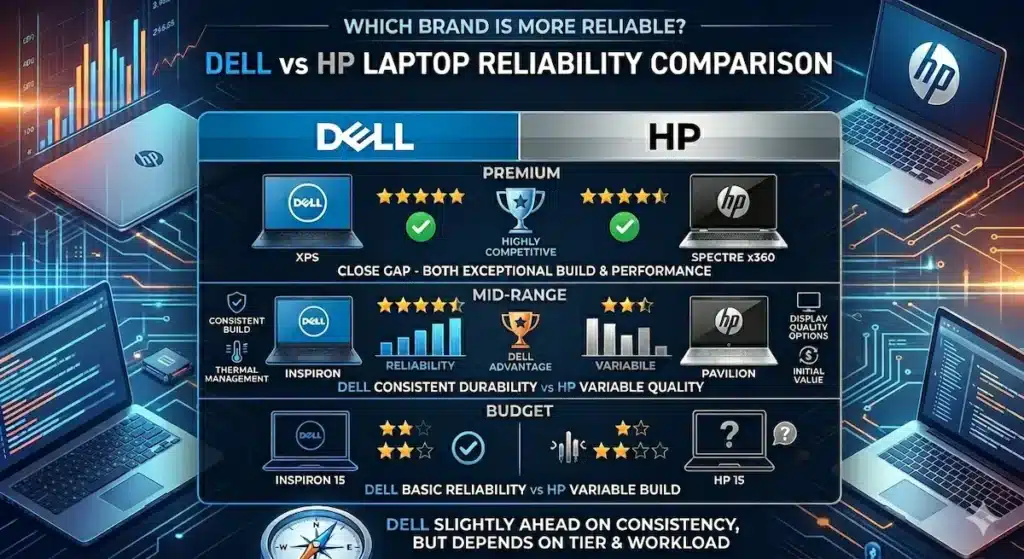
“Which brand makes better laptops at the price I’m buying?” That answer depends on your price range. At budget and mid-range, Dell is more consistent. At premium, the gap closes and HP’s Spectre is genuinely exceptional.
“Which brand will give me fewer problems over three to four years?” Dell has the stronger reliability track record across comparable product tiers in most consumer analysis. But that advantage is more pronounced at mid-range and disappears at the premium level.
The mistake most buyers make is applying a brand-level answer to a product-level decision. Dell XPS and Dell Inspiron are different machines. HP Spectre and HP Pavilion are different machines. The reliability gap between Dell and HP exists at specific tiers, not across every product both brands make.
Dell vs HP Laptop Build Quality — Where the Difference Is Real
Dell’s build quality is the more consistent story across price tiers. A Dell Inspiron at $500 feels meaningfully sturdier than an HP Pavilion at $500 — not premium, but more structurally confident in the keyboard deck flex test and in how the hinge holds up after a year of daily open-close cycles.
The Dell XPS line sits among the best-built Windows consumer laptops at any price. Machined aluminum construction, tight lid tolerances, a rigid chassis that doesn’t creak or flex under moderate pressure — the XPS earns its reputation as a premium product that doesn’t just look premium. Dell’s Latitude business line goes further with MIL-STD-810H military durability testing standards inherited from enterprise use cases. That design philosophy flows downstream into Dell’s consumer lineup.
HP’s build quality tells a more variable story. At the premium tier — Spectre, Envy — HP’s construction is genuinely excellent and earns direct comparison to Apple’s MacBook chassis standards. The HP Spectre x360 is the closest Windows laptop to MacBook-level build confidence: tight tolerances, premium materials, a chassis that communicates quality from the first time you pick it up. For the Dell vs HP laptop build quality comparison at premium tier, HP wins on design refinement.
At the mid-range and budget levels, HP’s consistency drops. Pavilion and HP 15 machines can feel fine in a store and less reassuring after six months of real student or professional carry — more chassis flex, more variable hinge behavior, less structural confidence under the daily physical reality of bag carry and desk use.
Build quality verdict: Dell wins mid-range and budget consistency. HP wins premium design. At the tier most buyers actually shop — $500–$800 — Dell’s more conservative engineering is the more reliable choice.
Dell XPS 13 discounted priceDell vs HP Laptop Reliability Over Time — The Long-Term Picture
The Dell vs HP laptop reliability question over a two-to-four-year ownership period is where Dell’s enterprise heritage shows most clearly.
Dell’s mainstream consumer laptops — Inspiron, XPS — benefit from thermal management practices and component validation that come from engineering processes built for business use. Enterprise machines have to work reliably under sustained professional workloads. That engineering discipline doesn’t disappear when the product ships with a consumer label.
In real extended testing, Dell Inspiron and XPS configurations under Ryzen or Intel Core processors maintain more consistent performance across sustained workloads. Fan behavior is more gradual — building as heat accumulates rather than spiking suddenly. Keyboard surface temperatures under equivalent load are measurably lower. These aren’t dramatic differences in isolated sessions, but they compound meaningfully across years of daily use.
HP’s slim consumer machines — thinner Envy and Pavilion configurations — show more thermal throttling under sustained heavy workloads. For students running development environments, remote workers in long back-to-back call sessions, or anyone running sustained processing for more than forty-five minutes: Dell’s thermal management produces a more dependable daily experience.
Industry reliability analysis consistently places Dell slightly ahead of HP in failure rate comparisons at equivalent price tiers. Dell’s enterprise lines — Latitude, Precision — undergo documented MIL-STD durability testing that sets a baseline for the broader product portfolio. HP matches that standard at the premium Spectre and Envy tier but shows more variability in the consumer segment.
Reliability verdict: Dell has the clearer long-term reliability advantage, particularly at mid-range and budget tiers. At premium tier, the gap narrows substantially.
Dell vs HP Laptop for Students — The Specific Comparison Most Readers Need
For students asking which is better Dell or HP for college, the practical question usually comes down to the Inspiron vs Pavilion comparison — similar price points, similar spec sheets, and a meaningful real-world experience gap over time.
A student buying a Dell Inspiron 15 and a student buying an HP Pavilion 15 at comparable configurations are getting similar hardware on paper. After twelve months of real campus use — daily bag carry, lecture hall open-close cycles, library study sessions, Zoom calls with everything else running — the Dell tends to accumulate fewer complaints. Less keyboard deck flex. More consistent hinge behavior. Less unpredictable thermal spiking under moderate workload.
The HP Pavilion 15 performs adequately through the first semester. By the second and third, the structural confidence gap between it and the equivalent Inspiron becomes more visible. Not catastrophic failure — just less reassurance that the machine is holding up the way a four-year investment should.
At the premium student tier, the comparison shifts. The HP Envy vs Dell XPS at $900–$1,200 is genuinely close. Both are well-engineered, both handle professional-adjacent student workloads confidently, and the build quality differences that show at budget tier largely disappear.
For most general students — humanities, business, social sciences, education: Dell Inspiron is the safer four-year recommendation for build reliability. HP Pavilion offers more display quality and initial value per dollar. Which matters more to your specific daily use determines the right call.
For creative students — design, photography, media: HP’s display options at mid-range through the Envy line are genuinely better and worth the consideration despite Dell’s reliability advantage elsewhere.
Dell vs HP Laptop for Business Use
In the Dell vs HP laptop for business comparison, Dell wins clearly for most professional environments — and the reason is the support infrastructure as much as the hardware itself.
Dell ProSupport is the benchmark against which business laptop support is measured in enterprise IT. Next-business-day on-site service, dedicated business account management, and hardware replacement logistics that are reliably followed through make Dell the safe institutional choice. For professionals who genuinely cannot afford unplanned downtime — client-facing roles, project-critical workflows, IT environments where equipment failure has real operational cost — Dell’s support maturity is a substantive advantage.
HP Care Pack is a solid warranty offering appropriate for many professional contexts. For individual professionals and small business owners buying at the consumer tier, both brands offer comparable warranty accessibility and the distinction is smaller. Dell is more conservative and reliable in its enterprise offering. HP sometimes provides better value configurations at equivalent price points.
Dell vs HP Laptop Display Quality — HP’s Clear Advantage
The Dell vs HP display quality comparison is where HP wins most consistently at mid-range price points, and it’s worth understanding why.
HP offers OLED and high-refresh-rate panels more frequently in the Envy and Spectre lines at $700–$1,100. The HP Spectre x360 OLED display is genuinely exceptional — color accuracy, contrast ratio, and visual quality that makes editing, streaming, and extended reading noticeably better than most Windows displays at the same price. For content creators, photographers, and students in visual programs, HP’s display options at this tier represent real daily value.
Dell reserves premium display options primarily for XPS and Alienware. Mid-range Inspiron displays are functional — adequate for productivity and standard student coursework — but not the visual experience HP delivers through comparable Envy configurations. For display-critical work, HP’s mid-range and premium options are the better choice.
Display verdict: HP wins clearly at mid-range. Dell wins only if you’re buying XPS, where premium display options are available.
HP Pavilion 15 Latest PriceDell vs HP Laptop Battery Life
The Dell vs HP battery life comparison doesn’t have a clean brand-level winner — it depends more on specific configuration than brand identity.
At premium tier: Dell XPS 13 with its large-capacity battery configuration is among the best Windows battery performers available. HP Spectre has improved significantly in recent generations with adaptive charging features that preserve long-term battery health well.
At mid-range: Dell Inspiron configurations tend to deliver more consistent battery across moderate mixed workloads. HP Envy competes strongly but shows more variability based on display brightness and workload intensity.
MacBook Air vs Dell XPS 13 for students
At budget tier: HP Pavilion and Dell Inspiron 15 configurations both land in the 6–8 hour real-world range under mixed student use. Neither brand has a systematic advantage here.
Battery life is determined more by battery capacity, processor efficiency, and display power draw in the specific configuration than by brand. Shop by configuration, not by logo, when battery matters to your decision.
Dell vs HP Laptop for Gaming
Both brands have gaming-specific lines that serve distinct audiences in the Dell vs HP gaming laptop comparison.
Dell’s Alienware is the premium gaming benchmark — thermal headroom, sustained performance under extended gaming load, and display quality for competitive environments. For serious gamers who want maximum gaming capability without compromise, Alienware remains the reference standard.
HP’s Omen targets gamers who want capable gaming performance in a less aggressive aesthetic — appropriate for carrying to class or work alongside gaming use. Omen machines typically offer better performance-per-dollar than Alienware at comparable tiers, trading some thermal headroom for better value and design restraint.
Neither brand’s gaming line is categorically superior. They serve different gamer profiles: Alienware for maximum performance priority, Omen for value and versatility.
Common Mistakes When Deciding Dell vs HP Laptop Which Brand Is More Reliable
Applying brand reputation to individual product decisions. The Dell vs HP laptop which brand is more reliable question doesn’t have a brand-level answer that applies to every product. Dell Inspiron and Dell XPS are different machines. HP Spectre and HP Pavilion are different machines. Reliability comparisons only make sense at equivalent product line tiers.
Buying HP’s thinnest consumer models for demanding workloads. HP’s slim Envy and Pavilion machines are optimized for portability and design. Under sustained heavy workloads, some throttle more aggressively than Dell equivalents. If your workflow is demanding and sustained, prioritize thermal management over the thinnest possible chassis.
Choosing based on first-impression build feel in a store. Chassis quality is better assessed after six months of daily carry than after five minutes of handling in a retail environment. Dell’s mid-range advantage in build consistency shows up over time, not necessarily during the initial evaluation.
Ignoring the support infrastructure for professional purchases. For business and professional use where uptime matters, Dell ProSupport’s maturity is a substantive advantage that the initial purchase price comparison doesn’t capture.
Frequently Asked Questions
Dell vs HP laptop — which brand is more reliable for everyday use?
For everyday use at mid-range and budget price points, Dell is more reliably consistent in build quality and thermal management across equivalent product tiers. At premium price points, the gap narrows and both brands produce genuinely excellent machines.
Is Dell better than HP for college students?
For long-term build reliability and thermal stability: Dell. For display quality and initial value per dollar: HP. The Dell vs HP laptop for college students decision depends on whether four-year durability or display quality is the higher priority for your specific program.
Which brand is better for business — Dell or HP?
Dell for most professional environments, primarily due to ProSupport’s maturity and the enterprise-lineage durability of Latitude and XPS lines. HP Care Pack and the Spectre line are appropriate for professional use, but Dell’s support infrastructure is more consistently reliable for environments where uptime genuinely matters.
Is HP Spectre more reliable than Dell Inspiron?
Yes — the HP Spectre is a premium product that competes with Dell XPS, not Dell Inspiron. Comparing them is comparing different tiers. At equivalent tiers, Dell Inspiron is more reliable than HP Pavilion, and HP Spectre is comparable to Dell XPS.
Dell Inspiron vs HP Pavilion — which lasts longer?
Based on real-world extended use and industry reliability analysis, the Dell Inspiron vs HP Pavilion comparison favors Dell for four-year durability. Consistent build quality, better thermal management, and more conservative engineering choices produce better long-term structural confidence in the Inspiron line.
Final Verdict — Dell vs HP Laptop: Which Brand Is More Reliable?
The Dell vs HP laptop which brand is more reliable question has a clear directional answer — Dell — with an important qualifier — at the right tier.
Dell is more reliable at mid-range and budget. Build quality consistency, thermal management, and long-term structural durability are all stronger in Dell’s mainstream lineup than in HP’s equivalent tier. For most students buying in the $500–$800 range and most professionals who want a machine that holds up across years of daily use, Dell is the safer choice.
HP competes at premium tier and wins on display. The HP Spectre is exceptional — genuinely one of the best Windows laptops available at any price, regardless of brand. HP’s mid-range Envy display options are better than Dell’s equivalent Inspiron panels. For students and professionals for whom display quality is the daily priority, HP earns its consideration alongside Dell XPS.
The practical guidance for most buyers in 2026:
If you’re buying at $500–$800: lean Dell for build reliability that holds up across two to four years of real use.
If you’re buying at $800–$1,200: compare Dell XPS and HP Spectre or Envy directly — both are excellent, and the decision shifts to display quality preference and software ecosystem.
Neither brand will let you down if you match the right product line to your workload. Both will disappoint you if you buy the wrong tier — regardless of which logo is on the lid.
About BestLaptopGuide.com: Our editorial team evaluates laptops through real-world testing and extended daily use — not manufacturer benchmarks. Recommendations updated regularly.
Disclosure: Some links on this page are affiliate links. A small commission may be earned at no extra cost to you. This does not influence our recommendations.