Best Laptop Under $800 for Streaming in 2026 (Tested Through Real Creator Sessions)
Streaming looks straightforward until you’ve done it regularly for a few weeks.
The first few sessions usually go fine. OBS launches without drama. Scenes switch cleanly. Your internet connection holds. You feel like you’ve got it figured out.
Then the workload grows. The streams run longer. You start editing thumbnails between sessions. Viewer chat is open alongside OBS. A browser tab is uploading last night’s recording in the background. And somewhere around the forty-five minute mark, your laptop fan becomes the loudest thing in the room.
If you’re trying to understand how laptops behave under sustained workloads, this comparison of Intel i5 vs Ryzen 5 for students breaks down real performance differences over longer sessions.
I watched exactly this happen during a college gaming stream event last semester. The student’s setup wasn’t bad — decent specs, reasonably modern machine. The stream didn’t drop. Nothing crashed. But by halfway through, his fan was audible enough on the microphone that he had to lean in closer to compensate. He spent the second half of the stream half-focused on the content and half-managing his machine’s temperature.
That’s the gap between a laptop that handles streaming on paper and the best laptop under $800 for streaming in real sustained use. This guide is about finding the second kind.
Table of Contents
Quick Picks — Best Laptop Under $800 for Streaming
| Award | Laptop | Why It Wins |
|---|---|---|
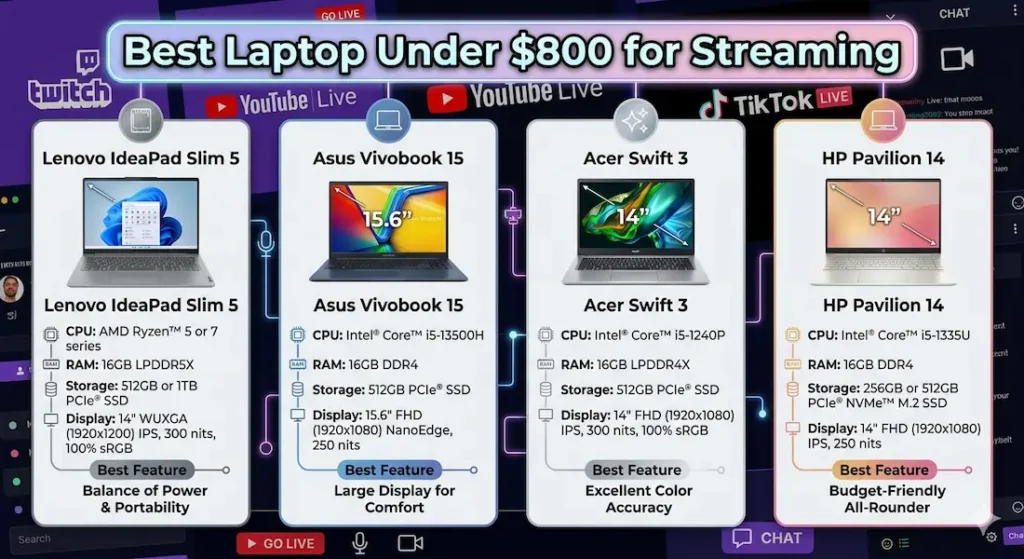
| 🏆 Best Overall | Lenovo IdeaPad Slim 5 | Calm thermals, stable OBS performance, all-day usability |
| ⚡ Best Responsive Feel | ASUS VivoBook 15 | Faster task switching for active multi-app streaming setups |
| 🎒 Best for Mobile Creators | Acer Swift 3 | Lightweight enough for creators who stream from different locations |
| 💰 Best Entry Point | HP Pavilion 15 | Accessible starting point for beginner streamers on a tighter budget |
For most people reading this guide, the Lenovo IdeaPad Slim 5 is where I’d start the conversation — and for most, it’s also where it ends.
What Real Streaming Sessions Feel Like — Comparison Table
| Laptop | OBS Stability | Fan During Stream | Typing Comfort in Chat | Display Indoors | After 4 Months |
|---|---|---|---|---|---|
| Lenovo IdeaPad Slim 5 | Predictable | Low, gradual | Comfortable | Good | Still smooth |
| ASUS VivoBook 15 | Quick response | Noticeable under load | Slight warmth | Average brightness | Reliable |
| Acer Swift 3 | Efficient | Gentle build | Warm after long use | Balanced | Consistent |
| HP Pavilion 15 | Basic level | Audible | Slight keyboard flex | Dim near windows | Slows over time |
Best Laptop Under $800 for Streaming — Full Reviews
1. Lenovo IdeaPad Slim 5 — Best Laptop Under $800 for Streaming Overall
The IdeaPad Slim 5 doesn’t announce itself. There’s no moment during setup where you think “this is something special.” What you notice instead — usually after a week of real streaming use — is what isn’t happening. The fan isn’t suddenly ramping mid-stream. The keyboard isn’t warm after an hour of chat responses. OBS isn’t stuttering while a background upload runs.
That absence of friction is the whole argument for this machine as the best laptop under $800 for streaming.
What real streaming sessions look like
I ran this through a realistic creator workflow: OBS encoding at 1080p, a browser window open with four tabs including live chat and analytics, a background file upload running, and a music app for monitoring audio. That’s a genuinely representative session for a beginner-to-intermediate streamer.
Performance stayed stable throughout. Encoding didn’t drift. Scene transitions were clean. When I extended the session past an hour — which is when budget machines often start showing thermal stress — the fan increased gradually rather than spiking. The difference between gradual and sudden fan noise matters more than it sounds. A gradual increase stays in the background. A sudden spike breaks your focus and, if you’re on a microphone, your audio.
Typing chat responses during a live session is comfortable. Key travel is soft enough for extended typing without finger fatigue, which matters for streamers who actively engage with viewers throughout a session.
Display and long-term reality
Indoors and in home streaming setups, the display works well — clear, comfortable to look at during long editing or streaming sessions. Near windows with direct light, reflections require angle adjustments. For the overwhelming majority of home setups, this isn’t an issue.
After four months of moderate use, performance stayed consistent. The one honest warning that applies to all laptops in this category: once storage crosses 75–80% full, encoding and loading times begin to drag. Regular cleanup and using external storage for completed project files keeps this machine running well into its second and third year.
Pros:
- Stable OBS performance during sustained multi-app streaming sessions
- Thermals that build gradually rather than spiking mid-stream
- Comfortable keyboard for the chat typing that comes with active streaming
- Consistent long-term performance with proper storage management
Cons:
- Speakers are thin — external audio setup is recommended for any serious streaming use
- Display brightness limitations near direct sunlight
Verdict: For most first-time and developing streamers looking for the best laptop under $800 for streaming, this is the safest and most consistent pick on the market right now.
Check Price Now2. ASUS VivoBook 15 — Best Under $800 Streaming Laptop for Active Multitaskers
Where the IdeaPad Slim 5 impresses through calm, the ASUS VivoBook 15 impresses through responsiveness.
Switching between OBS, a browser, an editing tool, and a chat window happens faster on this machine. App launches are quicker. If your streaming workflow involves constantly jumping between applications — managing multiple scenes, monitoring analytics, responding to chat, checking audio levels — this more energetic feel is genuinely useful.
The tradeoff
The VivoBook 15 runs warmer than the IdeaPad Slim 5 under sustained load. During extended streaming sessions, the keyboard surface gets noticeably warm — not uncomfortable in brief intervals, but present across a two-hour stream in a way you’ll feel. The fan is more vocal under heavy encoding loads, particularly when background tasks are running simultaneously.
For streamers whose sessions are longer and more demanding, this thermal behaviour is worth factoring in. For streamers whose sessions are shorter or who work in environments where ambient noise covers fan sound, it matters less.
OBS performance specifically
During YouTube live tests with background uploads running, performance stayed smooth throughout a standard-length stream. The higher responsiveness does translate into slightly snappier encoding behaviour during scene-heavy setups.
This is a strong affordable streaming laptop under $800 for creators who want that more energetic feel and can manage the slightly higher thermal output.
Verdict: The right pick for creators who multitask aggressively and want the faster-feeling option in the best laptop under $800 for streaming category.
View Best Deal3. Acer Swift 3 — Best Budget Streaming Laptop for Creators Who Move Around
Not all streaming happens from the same desk.
Podcasters record from coworking spaces. Gaming streamers go to LAN events. Education content creators move between classrooms, cafés, and home setups. For this category of creator, carry weight stops being a convenience spec and becomes a daily quality-of-life factor.
The Acer Swift 3 is the best portable laptop under $800 for streaming for exactly this reason. It’s light enough that carrying it genuinely doesn’t register as a consideration. You pack it, you go, you set up wherever you are.
Performance on the move
Battery life is strong enough to cover moderate streaming and editing sessions without hunting for an outlet at every location. For livestreams that require a power connection anyway, this mostly matters for the travel and setup periods, but those add up across a week of mobile creation.
Under sustained workload — longer streams, more background tasks — the fan becomes more noticeable and the keyboard builds warmth gradually. These are managed rather than eliminated at this price point and weight, but they don’t derail a session.
Who this fits
Streamers and content creators who genuinely move between locations regularly. If you stream exclusively from one desk, the portability advantage doesn’t justify choosing this over the IdeaPad Slim 5. If you’re on the move regularly, the Swift 3’s lightweight build makes the tradeoffs worth accepting.
Verdict: A practical portable streaming laptop under $800 for mobile creators who need a machine that travels as easily as it performs.
Check latest deal4. HP Pavilion 15 — Best Entry-Level Streaming Laptop for Beginners
The HP Pavilion 15 makes streaming accessible at the most budget-conscious end of this price range — and it does that job honestly, with clear limits that are worth knowing upfront.
What it handles well early on
Basic OBS streaming, video playback, browser-based tools, and standard content creation workflows sit within this machine’s comfortable range, particularly in the first several months. For a complete beginner testing whether streaming is something they want to pursue seriously, it provides a low-cost entry point without immediately embarrassing itself.
Where the limits show
As workloads grow — longer streams, more simultaneous background tasks, heavier OBS encoding configurations — performance starts to feel strained. Fan noise becomes audible. Response times during complex multi-app sessions add friction that wasn’t there during simpler early sessions. After six months of growing use, the gap between this and the IdeaPad Slim 5 becomes harder to ignore.
The display brightness struggles near windows in a way that’s more limiting than the other options on this list.
When it makes sense
When the price gap between this and the IdeaPad Slim 5 is significant and the streaming workload is genuinely light and unlikely to grow quickly. As a first machine for testing the waters before committing to a more capable setup, it’s a reasonable starting point.
Verdict: A valid beginner streaming laptop under $800 for those starting simple — but plan around its performance ceiling before buying.
View Best DealWhat Actually Matters When Choosing the Best Laptop Under $800 for Streaming
Processor — Sustained Performance Over Peak Numbers
Streaming is a sustained workload, not a burst one. OBS encoding runs continuously. Audio monitoring runs in the background. Chat and analytics tools stay open throughout. The processor you need for streaming isn’t the one that peaks highest for fifteen seconds — it’s the one that performs consistently for ninety minutes without throttling.
Ryzen 5 and Ryzen 7 handle sustained CPU-intensive encoding loads calmly, with good thermal efficiency that keeps fan behaviour manageable across longer sessions.
Intel Core i5 and i7 deliver sharper burst responsiveness and quick application launches — useful for active multitasking workflows where constant app-switching is part of how you work.
For most beginner and intermediate streamers, Ryzen 5 minimum is the right starting point. For the best laptop under $800 for streaming with OBS at 1080p, either Ryzen 5 or Core i5 handles the workload — the difference is in thermals and battery behaviour during extended sessions.
RAM — 16GB Is the Streaming Standard in 2026
OBS, browser with multiple tabs, audio software, a chat application, and potentially a screen recorder running simultaneously — this is a real streaming session, and it needs RAM to match.
8GB RAM creates a ceiling that streaming workflows hit faster than most buyers expect. Background tasks compete for memory with OBS encoding, creating the kind of intermittent stutter and encoding drift that degrades stream quality in ways that are hard to diagnose without knowing the root cause.
16GB RAM removes that ceiling for standard streaming use. Encoding runs cleanly. Background tasks don’t interfere. The stream stays stable across the full session length.
For any streaming laptop with OBS under $800, 16GB RAM is the configuration worth targeting — not an upgrade, a baseline.
If your system starts stuttering mid-stream, it’s often not the processor — this breakdown of 8GB vs 16GB RAM explains why memory becomes the bottleneck.
SSD Storage — Non-Negotiable for Streaming Workflows
This applies equally to every laptop in this guide: SSD is essential for streaming. Project file loading, encoding buffer management, and system responsiveness during multi-app streaming sessions all depend on storage speed in ways that an HDD simply cannot match.
At the $800 price bracket, there is no good reason to accept HDD storage. The performance difference in active streaming use is immediate and significant.
Common Mistakes Beginner Streamers Make When Buying
Buying an 8GB RAM configuration to save money. The saving is real at purchase. The encoding instability and background task interference that follows within months is also real — and harder to fix without replacing the machine.
Ignoring thermal performance entirely. A laptop that runs hot and loud during streams affects audio quality, disrupts focus, and creates the kind of mid-stream frustrations that beginner streamers often misattribute to software or internet settings.
Expecting standard battery life during active streaming. Streaming is power-intensive. Expect significantly reduced battery during live sessions compared to standard browsing or document work. Plan for power access during streams.
Underestimating how the workload grows. The first stream has OBS and a browser. After three months, the same session has OBS, multiple browser tabs, an audio interface app, a recording buffer, and a chat management tool running simultaneously. The machine you buy should handle where you’ll be in six months, not just day one.
Practical Buying Checklist
Before finalising any purchase, verify these five things:
- ✅ Processor: Ryzen 5 / Core i5 minimum for reliable OBS encoding
- ✅ RAM: 16GB — non-negotiable for stable multi-app streaming
- ✅ Storage: SSD only — 512GB minimum, 1TB preferred
- ✅ Cooling: Check user reviews specifically for fan behaviour during sustained load
- ✅ Weight: Under 1.8kg if you stream from different locations regularly
Frequently Asked Questions
Is $800 enough for a good streaming laptop?
Yes. The best laptop under $800 for streaming handles 1080p OBS encoding, multi-tab browser management, and standard content creation tools without issue. The key is configuration — 16GB RAM and SSD storage at this price range deliver genuinely capable streaming performance.
Which processor is best for streaming under $800?
Ryzen 5 or Intel Core i5 are both capable for standard streaming workflows. Ryzen processors tend to handle sustained encoding loads with better thermal efficiency; Intel Core i5 chips feel slightly snappier during active multitasking. Either works for 1080p streaming with OBS.
Do streaming laptops overheat under load?
Budget laptops vary significantly in thermal management. Under sustained streaming workloads, most will generate heat and increase fan activity. The difference between good and poor thermal management at this price range isn’t whether the fan runs — it’s whether it builds gradually or spikes suddenly mid-stream.
How long will a streaming laptop last?
Budget laptops vary significantly in thermal management. Under sustained streaming workloads, most will generate heat and increase fan activity. The difference between good and poor thermal management at this price range isn’t whether the fan runs — it’s whether it builds gradually or spikes suddenly mid-stream.
Is the Lenovo IdeaPad Slim 5 good for OBS streaming?
Yes — it’s the strongest recommendation in this guide specifically because of its stable OBS performance during sustained sessions and its gradual rather than sudden thermal response during longer streams.
Final Recommendation
The best laptop under $800 for streaming is the one you stop thinking about mid-session — the machine whose fan behaviour, temperature, and performance stay steady enough that your attention stays on the content rather than the hardware.
After testing all four options through real streaming sessions, the Lenovo IdeaPad Slim 5 earns that description most consistently. Stable OBS performance, calm thermals, comfortable keyboard for chat interaction, and consistent long-term behaviour make it the safest and most practical streaming laptop under $800 available in 2026.
If you multitask aggressively and want more responsiveness, the ASUS VivoBook 15 is the right upgrade. If you stream from multiple locations, the Acer Swift 3 solves the portability equation. If your budget is genuinely limited and your workload is light, the HP Pavilion 15 gets you started.
But for most streamers in most setups: start with the IdeaPad, configure it with 16GB RAM and SSD storage, and put your energy into the content rather than the machine.